
Homepage
CASE STUDY
RMP Electrical: getting found locally across West London and the Thames Valley, with a lead pipeline that does not lose enquiries.
Ryan Pumfrey runs RMP Electrical out of Hayes, West London. Fully qualified and insured, working seven days a week, self-certifying notifiable work as a registered competent person under Part P. He is genuinely better than most of the multi-van firms ranking above him, the brief was to build a site that proves it on Google before the first call.
Homepage
Ryan Pumfrey runs RMP Electrical out of Hayes, West London. Fully qualified and insured, working seven days a week, self-certifying notifiable work as a registered competent person under Part P. His problem was a common one for sole traders in a saturated category: he is genuinely better than most of the multi-van firms ranking above him, but his old site did not show it.
No strong local presence. No clear conversion path. Nothing on the page that made a homeowner or landlord trust him over the company with the bigger Google Ads budget. The brief was straightforward: build something that gets found locally, converts visitors into enquiries, and does not look like the generic blue trades template every other electrician in the area is using.
Trades customers do not browse. They have a problem, they search, they pick someone who looks competent and local, and they call or message. The entire site was built around that behaviour.
One conversion path. Three contact options, call, WhatsApp, or a short form, all reaching Ryan directly within seconds. No call centre. No inbox checked once a day. The form is three fields: what is the job, your postcode, your number. Email is optional. Conversion friction is near zero.
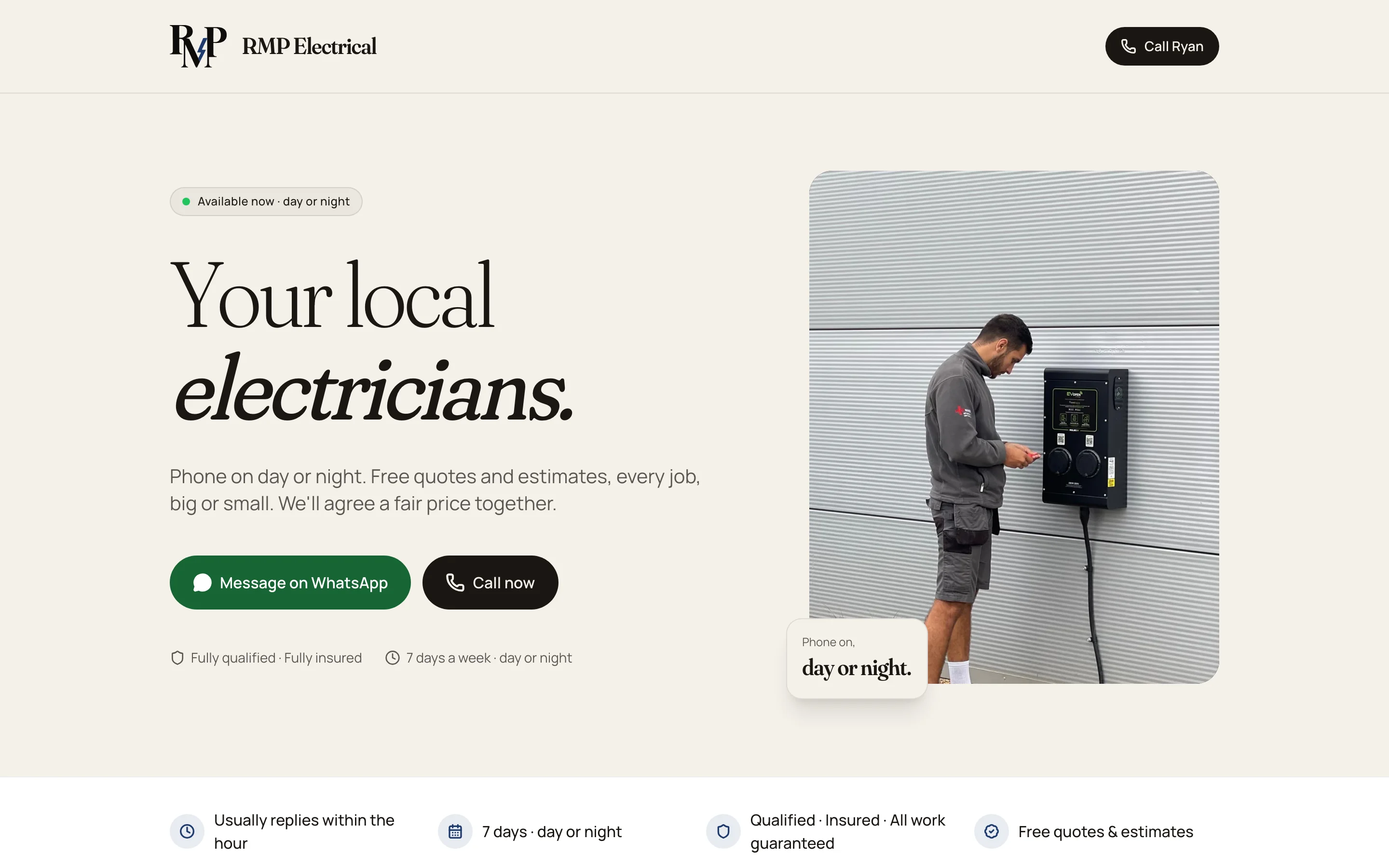
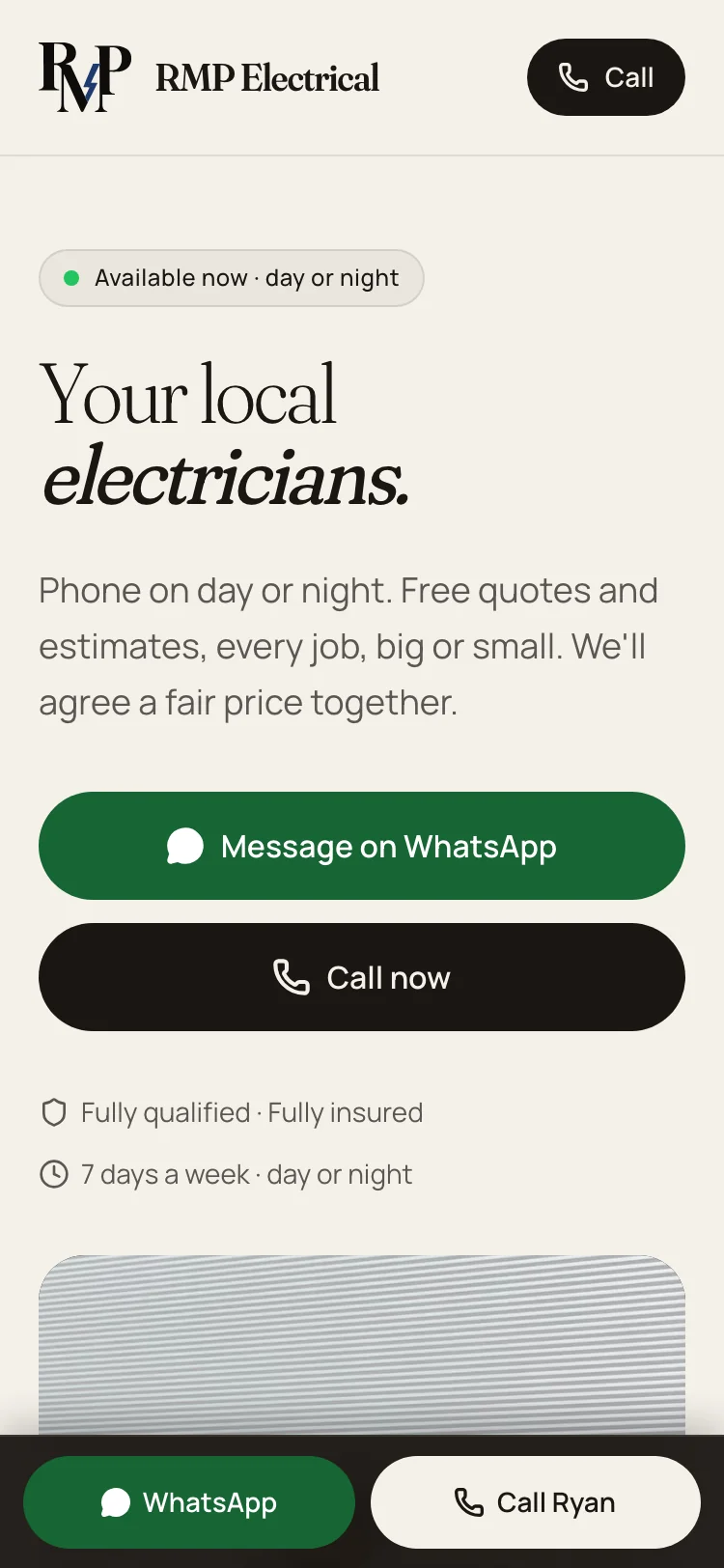
The visual direction is deliberately not the generic blue corporate trades template. Cream palette, editorial typography, real photography intent, mobile-first layout with a sticky call bar and a floating WhatsApp button. The phone number is never more than a thumb-tap away, because the majority of people searching for an electrician are doing it on their phone.
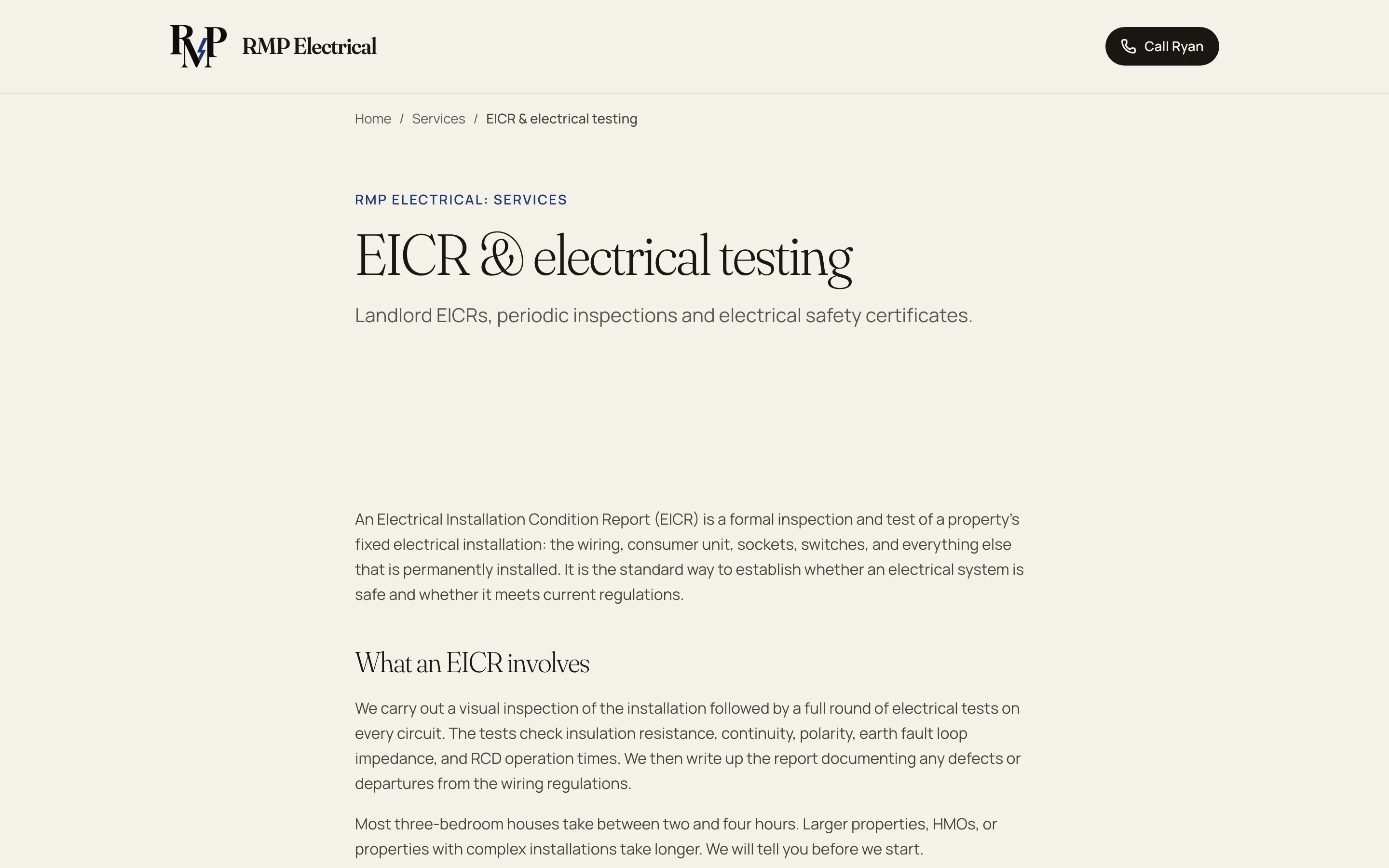
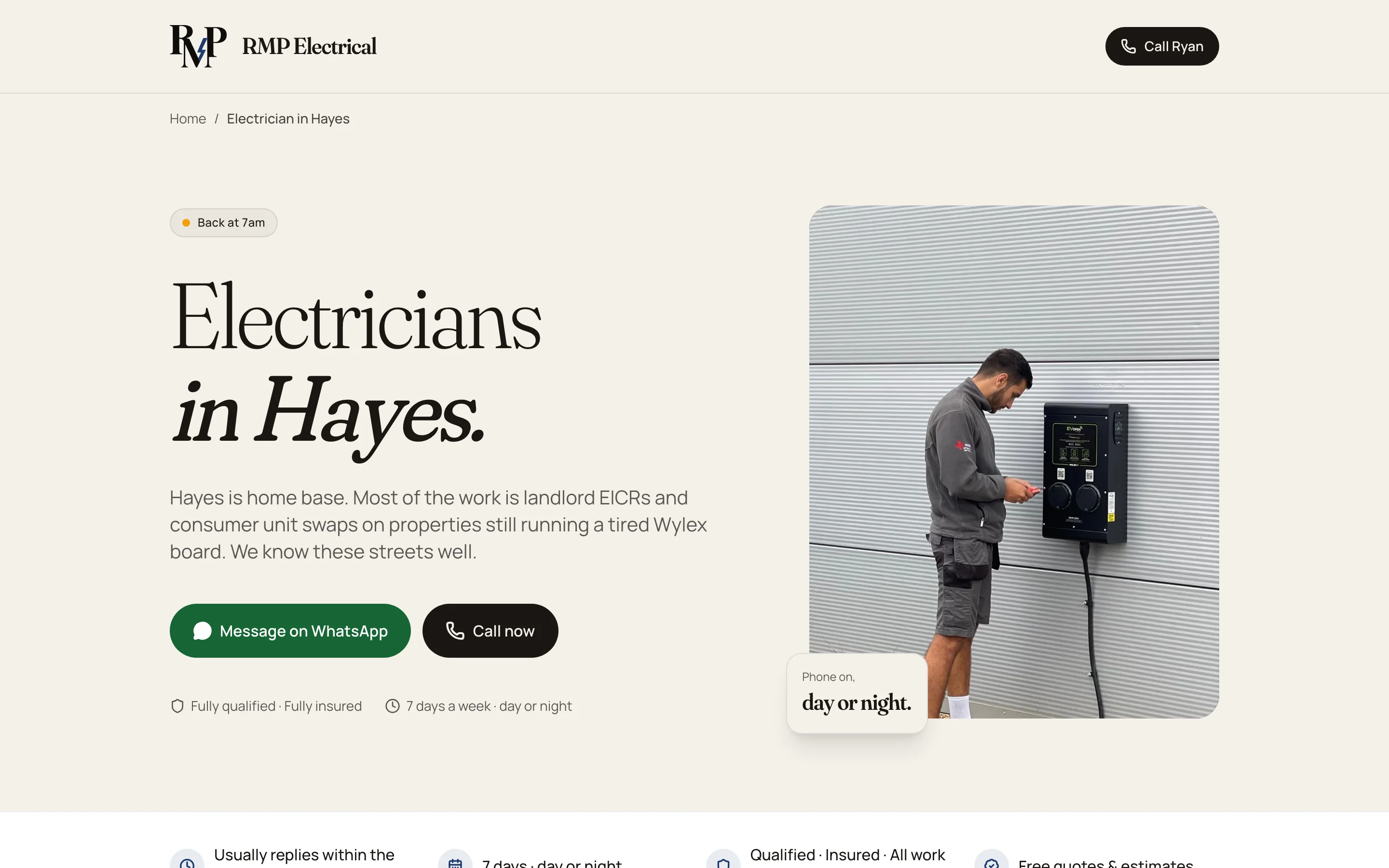
Local SEO was built on real content rather than duplicated city pages. RMP has 31 hand-written location pages, one for each priority service area across West London and the Thames Valley: Hayes, Uxbridge, Slough, Maidenhead, High Wycombe, Reading, Oxford, Windsor, and more. Each page has a unique intro, a description of the local property stock, the typical jobs called for in that area, and a postcode that pre-fills the quote form when a visitor lands on it.
Every page carries structured data that tells search engines, and increasingly, AI assistants, exactly who Ryan is, what he does, where he operates, and when he is available. That includes FAQ schema wired to the visible questions on the page, which surfaces in voice search and AI-generated answers. A dedicated /llms.txt file gives ChatGPT, Perplexity, and similar tools a canonical, structured description of the business pulled live from the CMS.
The lead pipeline was engineered so no enquiry is ever lost. Every form submission fans out to four destinations in parallel: an SMS to Ryan, a backup email to Ryan, an SMS confirmation to the customer, and a branded email confirmation to the customer. The submission is also written to the CMS as a permanent lead record regardless of what happens with the other four. If Twilio goes down, Resend picks it up. If both fail, the lead is still in the database. All three would have to fail simultaneously before a single enquiry is lost. Spam is handled without friction: an invisible CAPTCHA, a honeypot field bots fill in silently, and a cross-instance rate limiter. Genuine customers never see any of it.
Ryan has a CMS at /studio where he controls every word on the site, copy, photos, FAQs, service areas, opening hours. He can update his phone number without calling us. He can add a job photo without involving a developer. The same CMS doubles as a lead inbox: every enquiry that comes through the form appears as a record with per-channel delivery confirmations, the source page, and the referrer. Ryan knows an enquiry arrived and that it was delivered successfully to his phone.
One conversion path, three contact options, zero friction on mobile.
Thirty-one hand-written location pages, no duplicated city-stamping.
Four delivery paths fan out in parallel from every form submission.
Sanity Studio doubles as the site CMS and the lead inbox.
A high-intent service page plus one of the thirty-one hand-written location pages, desktop and mobile.
Structural claims you can verify by visiting the live site.
What we used and why.
A sole trader who now competes with multi-van firms on Google. The site is built for how trades buyers actually decide, found locally across West London and the Thames Valley, with a redundant lead pipeline that does not lose enquiries and an owner who can run it without a developer.
The trust signals on the page are real, not aspirational. Ryan is fully qualified and insured, self-certifying notifiable work as a registered competent person under Part P. Review stars are only shown when real reviews exist. The site is UK GDPR and PECR compliant with Google Consent Mode v2 in place. AVIF and WebP imagery, code splitting, font optimisation, and a UK-region serverless deploy mean it loads fast for the people most likely to convert.
The full site is at rmp-electrical.co.uk.
“Looks clean, works perfect on mobile and customers can WhatsApp me straight from the site. Would 100% recommend.”
“Doman Digital done my website and I'm really happy with it. Looks clean, works perfect on mobile and customers can WhatsApp me straight from the site. Would 100% recommend.”
If you run a trade and your site is not pulling its weight on enquiries, get in touch and we will show you exactly what is getting in the way.